
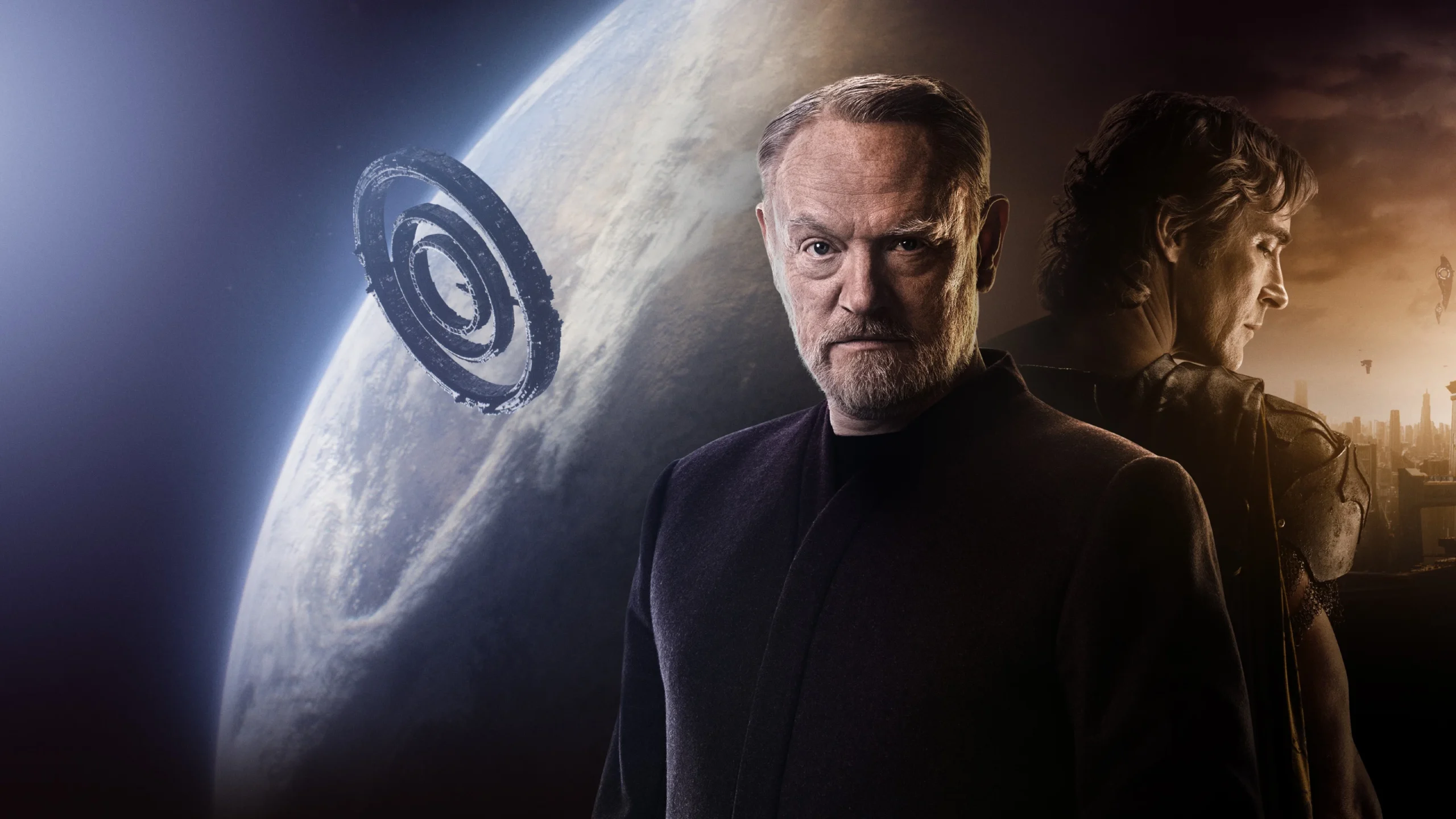
Hari Seldon has spent two seasons trying to save humanity from itself. He has predicted the collapse of a galactic empire, established a civilisation designed to survive the aftermath, and somehow managed to remain the most influential man in the galaxy long after his own death. Not bad for a mathematician. But there's a possibility that Foundation has been quietly building towards something far more unsettling: what if Hari's greatest mistake isn't getting the future wrong, but making sure it happens?
⚠️ SPOILER WARNING
This article contains major spoilers for Foundation Seasons 1 and 2. It does not discuss Season 3 or reveal events from Isaac Asimov's novels.
The Problem With Knowing the Future
Imagine somebody tells you that your house is going to burn down.
Naturally, you panic. You start checking the wiring, replacing appliances and perhaps developing a slightly unhealthy relationship with your smoke alarms. But suppose all those precautions somehow lead to the fire itself.
Did the prediction come true because it was accurate, or because you believed it?
That, essentially, is the question at the centre of our theory about Hari Seldon.
In Foundation, psychohistory uses mathematics to predict the behaviour of enormous populations. Individual people are unpredictable, but over sufficiently vast numbers and timescales, Hari believes that humanity follows patterns that can be calculated.
His most terrifying conclusion is that the Galactic Empire will collapse, plunging civilisation into 30,000 years of darkness. His Plan aims to shorten that period to just 1,000 years.
It's an extraordinary ambition. But the series has repeatedly demonstrated that Hari isn't content simply to predict events.
He actively intervenes to make them happen.
And that changes everything.
Hari Seldon Isn't Just Predicting History. He's Writing It.
Think about what Hari actually does in Season 1.
He doesn't publish his findings, warn the galaxy and leave humanity to decide what to do. Instead, he orchestrates the creation of the Foundation, sending a carefully selected group of people to Terminus under the pretence of preserving knowledge.
What they're really doing is becoming participants in a much larger experiment.
The Foundation's early inhabitants don't understand the full purpose of their mission. They certainly don't know everything Hari knows about the crises they will face. Their ignorance isn't an unfortunate side effect of the Plan. It's practically built into its operating instructions.
Then there's the Vault.
For a man who believes history is driven by populations rather than individuals, Hari has an astonishing habit of appearing at exactly the right moment to tell everyone what they should do next.
The First Crisis is a particularly revealing example. Hari's posthumous intervention helps turn conflict between Terminus, Anacreon and Thespis into an alliance. It's a remarkable achievement, but it depends on those societies being manoeuvred into a position where his solution becomes possible.
Hari isn't standing outside history with a clipboard, recording the results.
He's inside the experiment, moving the pieces around.
And once you realise that, a rather uncomfortable possibility emerges.
What if psychohistory is only accurate because Hari keeps arranging for its predictions to come true?
The Plan Has Become a Religion — Quite Literally
Season 2 makes this possibility considerably harder to ignore.
More than a century after the Foundation's establishment, Hari's followers are spreading their influence across the Outer Reach through the Church of Seldon.
Advanced technology is presented as something approaching the miraculous. The Foundation's knowledge becomes a source of religious authority, and its missionaries help persuade entire populations to align themselves with Seldon's cause.
From a practical perspective, it's brilliant.
If you want to change the future, convincing people that your chosen future is inevitable is a remarkably effective place to start.
But there's a darker interpretation.
The Foundation isn't simply protecting scientific knowledge from the coming collapse. It's cultivating a belief system that encourages people to trust Hari's vision above their own judgement.
The Plan effectively becomes a self-fulfilling prophecy with a priesthood.
There's something wonderfully ironic about a civilisation supposedly founded on mathematics turning its founder into a near-mythological figure. Somewhere, Hari's original academic colleagues are presumably having a very difficult time explaining that this wasn't quite what peer review was invented for.
And yet this religious phase isn't an accidental misunderstanding that develops centuries later.
It's part of the Foundation's strategy.
Which means Hari is willing to manipulate not only politics and technology, but belief itself.
That raises a difficult question: if humanity must surrender its independence to achieve the future Hari has calculated, what exactly is he saving?
The Destruction of Terminus Changes Everything
The strongest evidence for our theory comes towards the end of Season 2.
Terminus, the original home of the Foundation, is destroyed during Empire's attack.
It's an extraordinary moment. The entire project appears to have been wiped out, along with the people who devoted their lives to it.
Then the Vault reveals that it has preserved the Foundation's inhabitants.
The survival is remarkable. But Hari's explanation is even more revealing: the destruction of Terminus was part of what needed to happen for the Foundation to move forward.
Consider the implications.
The physical heart of the Foundation can be sacrificed, an entire population can experience the apparent destruction of its home, and Hari can still regard the outcome as consistent with his Plan.
Perhaps he's right. Perhaps that sacrifice genuinely protects billions of people who would otherwise suffer through a much longer dark age.
But we're being asked to accept that judgement largely because Hari says so.
And this is where the distinction between prediction and manipulation becomes frighteningly thin.
If Hari knows a catastrophic event must happen, does he try to prevent it?
Or does he arrange matters so that it happens in the least damaging way available?
Those aren't necessarily the same thing.
More importantly, if he believes a catastrophe is essential to his desired future, might he actually preserve the conditions that cause it?
It's one thing to accept that history involves terrible sacrifices.
It's another to become the person deciding which sacrifices history requires.
Gaal and Salvor Prove the Future Isn't Fixed
Fortunately, the series gives us a reason to doubt Hari's absolute certainty.
Gaal Dornick.
From the beginning, Gaal represents something Hari struggles to account for: an individual whose abilities and decisions can fundamentally disrupt his expectations.
Her departure from the original Foundation mission throws his arrangements into disarray. His intended path for the Second Foundation becomes much more complicated, forcing him to adapt rather than simply watch his calculations unfold.
Then Season 2 introduces an even more significant challenge.
Gaal sees a possible future involving the Mule and Salvor's death. Yet Salvor ultimately dies much earlier, sacrificing herself to save Gaal from an attack connected to Tellem Bond's lingering influence.
It's a devastating loss.
But it also demonstrates something enormously important.
The future can change.
Gaal's vision wasn't an unavoidable destination. Events took another path.
Of course, psychohistory isn't supposed to predict every individual's fate. Hari's mathematics concerns populations on a vast scale, so one altered personal outcome doesn't automatically invalidate the entire Plan.
But it does undermine the atmosphere of inevitability surrounding the story.
If the future can change through individual decisions, how many possible futures exist beyond the one Hari has selected?
And here's the really intriguing possibility.
What if the greatest threat to Seldon's Plan isn't someone disrupting it?
What if it's someone finally discovering a better alternative?
Demerzel Might Be the Most Dangerous Person in the Galaxy
By the end of Season 2, another character has acquired access to something extraordinarily powerful.
Demerzel possesses a Prime Radiant.
That means the Empire's most influential surviving figure now has access to the mathematical framework behind Hari's predictions.
And unlike the Cleons, Demerzel has the patience, intelligence and unusually long perspective to appreciate what that might mean.
There's an obvious interpretation: Demerzel could use psychohistory to help Empire resist its predicted collapse.
But consider a different possibility.
What if access to the Prime Radiant allows her to recognise just how much of the future has been shaped by Hari's interference?
Demerzel herself is trapped within an imposed system. Her loyalty to the Cleonic dynasty is enforced by programming, even when that obligation conflicts with her own desires.
She understands what it means to have her choices constrained by somebody else's vision.
In that respect, she and the Foundation's inhabitants have more in common than either side might appreciate.
Both serve systems designed by powerful men who claim to know what must happen next.
The difference is that Hari's system has mathematics to justify itself.
That doesn't necessarily make it morally superior.
Now imagine Demerzel examining the Prime Radiant and discovering that the Empire's downfall isn't merely predicted by the Plan.
It's partly being accelerated by the Plan's own interventions.
Suddenly, the struggle between Empire and Foundation becomes something very different.
Not a battle between a dying civilisation and its inevitable successor.
A battle between competing attempts to control history.
Two Haris, Two Versions of the Truth
There's another detail that makes Hari's position especially suspicious.
By Season 2, we're dealing with multiple versions of Hari Seldon, each following a different path.
The Vault's digital Hari guides the First Foundation, while the version travelling with Gaal becomes involved in establishing the Second.
Their experiences diverge. Their knowledge and perspectives aren't perfectly identical. Each operates under different circumstances, and neither is simply the original Hari continuing his life uninterrupted.
That's a fascinating problem for a Plan supposedly built around one coherent mathematical understanding of history.
What happens when the architect of the future begins disagreeing with himself?
More importantly, which version gets to decide what the Plan actually means?
The existence of multiple Haris suggests that even Seldon cannot entirely escape the unpredictability he's trying to control.
He has become another variable in his own equation.
One with an extremely large ego and a rather complicated relationship with being dead.
What If the Mule Isn't the Real Threat?
The end of Season 2 points towards the Mule as a major danger to Hari's carefully constructed future.
From what we've seen, the Mule possesses extraordinary mental abilities and represents something psychohistory may struggle to accommodate.
He's exactly the sort of unpredictable force that should concern someone trying to calculate humanity's destiny.
But perhaps we're looking at the threat from the wrong direction.
If our theory is correct, the most dangerous thing about the Mule might not be that he could destroy the Plan.
It might be that he could expose its limitations.
The entire Foundation project depends on the assumption that Hari's preferred path is humanity's best available future. That assumption has justified manipulation, secrecy, religious influence and enormous sacrifice.
Yet Seasons 1 and 2 have also shown us people making decisions that Hari didn't anticipate.
Gaal changes his arrangements. Salvor's actions demonstrate that the future isn't fixed. Demerzel now has the tools to investigate his calculations from outside the Foundation.
Perhaps the ultimate challenge to psychohistory won't be someone proving that mathematics is useless.
It will be someone proving that Hari mistook one possible future for the only acceptable one.
And if that happens, the Plan's greatest enemy might turn out to be humanity's freedom to choose.
The Real Theory: Hari Is Creating the Dark Age He's Trying to Prevent
So let's bring everything together.
Hari predicts the fall of Empire and establishes the Foundation to reduce the resulting dark age.
But the Foundation grows into an ideological, technological and eventually military challenge to the existing galactic order.
Its expansion contributes to the conflict with Empire, while Hari's interventions influence how successive crises develop.
None of this proves he originally caused the Empire's decline. The Cleonic dynasty is already deeply flawed, and its collapse may well have been inevitable without him.
That's an important distinction.
Our theory isn't that Hari invented the dark age out of nothing.
It's that his attempt to control the collapse may be making a particular version of that collapse unavoidable.
By committing humanity to one calculated route through history, Hari could be preventing other solutions from emerging.
Peaceful reform. Different alliances. Unexpected scientific discoveries. Individual choices that don't fit neatly into his equations.
All the things that become harder to imagine once everyone believes the future has already been decided.
And perhaps that's the real tragedy of Hari Seldon.
He may be so determined to spare humanity 30,000 years of suffering that he never stops to consider whether his own interventions are helping create the thousand years he considers unavoidable.
What Would It Mean to Break the Plan?
There's something wonderfully unsettling about the possibility that Foundation isn't ultimately telling us how humanity survives because of Hari Seldon.
It might be telling us how humanity learns to survive without him.
That wouldn't make Hari a villain. His intentions could be entirely sincere, and his calculations might still have prevented unimaginable suffering.
But good intentions aren't the same thing as infallibility.
And the more power Hari accumulates over history, the more dangerous his certainty becomes.
Perhaps the greatest achievement of the Foundation won't be fulfilling Seldon's Plan.
Perhaps it will be reaching the point where humanity no longer needs one man, one equation or one supposedly inevitable future to tell it what comes next.
After all, there's a fine line between saving civilisation and insisting that civilisation follow your instructions.
And Hari Seldon has never seemed particularly fond of other people changing the syllabus.
What do you think? Is Hari genuinely guiding humanity towards its best possible future, or could the Plan itself be preventing something better?
About the Show
Foundation is an epic science-fiction television series on Apple TV, inspired by Isaac Asimov's novels. It follows mathematician Hari Seldon's attempt to preserve civilisation after predicting the collapse of the Galactic Empire, exploring themes of power, destiny, religion, technology and humanity's ability to shape its own future.
Spoiler scope: Seasons 1–2 only. No Season 3 or book spoilers.