Some films impress you with their spectacle. Others leave you staring at the credits, quietly reconsidering your entire existence. Christopher Nolan's Interstellar somehow manages both. More than a decade after its release, its black holes, impossible worlds and astonishing visuals remain spectacular. But it's the painfully human story at its centre that keeps pulling us back.
⚠️ SPOILER WARNING
This article contains major spoilers for Interstellar (2014), including its ending. If you haven't watched it yet, we'd strongly recommend doing so before reading on. Ideally with a reasonably large television, decent speakers and absolutely no plans to be emotionally productive afterwards.
It's Not Really About Space, Is It?
On paper, Interstellar sounds like the ultimate science-fiction adventure. Earth is dying, humanity needs a new home, and a group of astronauts must travel through a wormhole to find somewhere that might support human life. There are distant galaxies, strange planets, a spectacular black hole and enough theoretical physics to make most of us question whether we were paying attention in school.
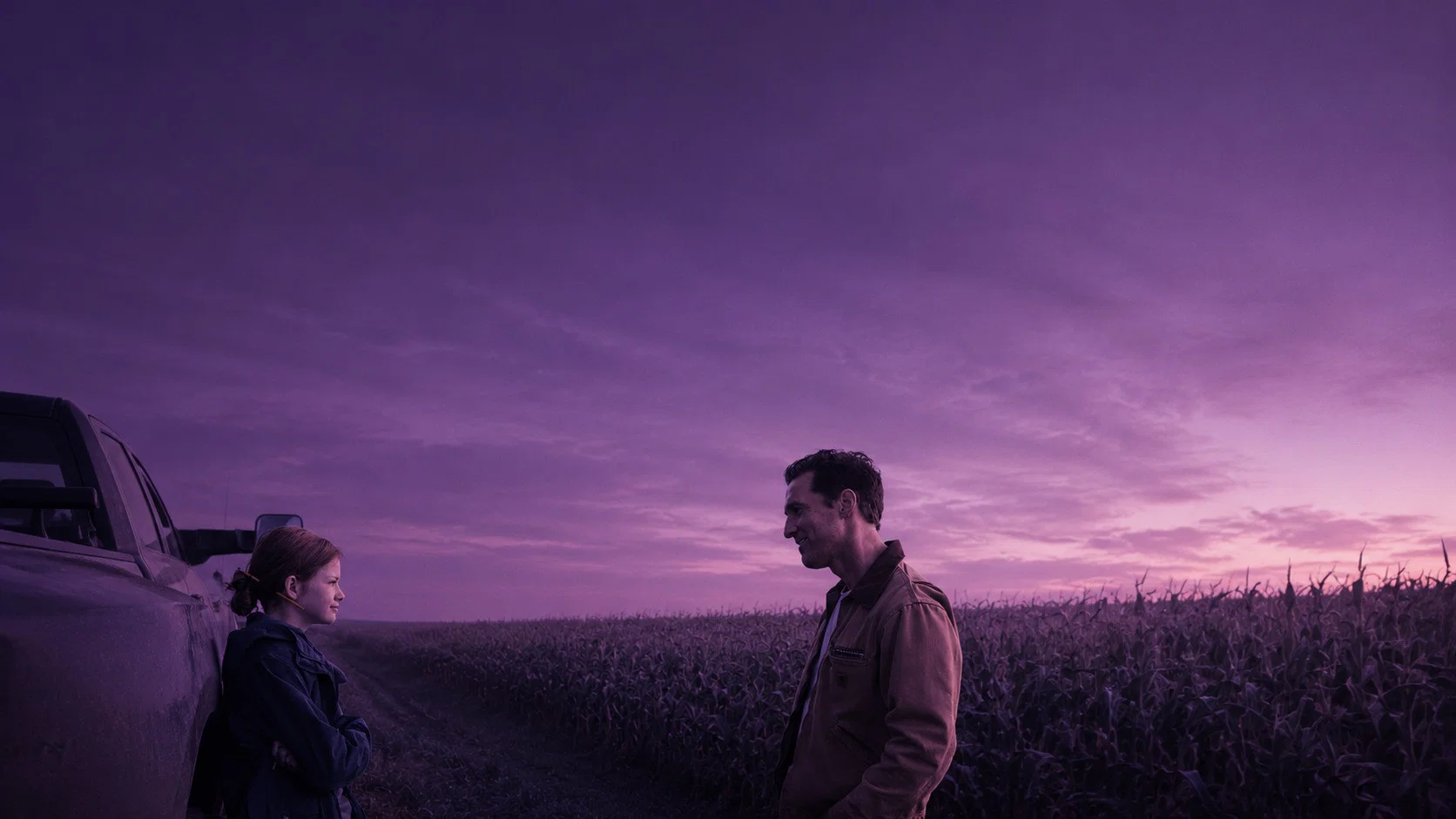
And yet, strip away the spaceships and scientific ambition, and Interstellar is fundamentally about a father who leaves his daughter behind. Cooper isn't exploring the universe because he's desperate to become humanity's greatest adventurer. He's going because he believes it might give his children a future, even though doing so means sacrificing the very thing he wants most: being there to share it with them.
It's an extraordinary contradiction. To save his family, he has to abandon them. To give his children more time, he must surrender his own time with them. And while the fate of humanity is certainly a substantial concern, it's the relationship between Cooper and Murph that gives the film its emotional weight.
That's what makes Interstellar different from so many other science-fiction epics. The universe might be enormous, but the story keeps bringing us back to one little bedroom, one bookshelf and a daughter desperately trying to understand why her father left.
Twenty-Three Years Gone in an Afternoon
There are plenty of unforgettable sequences in Interstellar, but few are as quietly devastating as Cooper returning from Miller's planet.
The concept is fascinating enough on its own. Because the planet orbits dangerously close to Gargantua, the enormous black hole, time passes at a dramatically different rate. Every hour on its surface amounts to approximately seven years for someone farther away. It's the sort of scientific idea that sounds brilliant until you start considering what it would actually mean.
The crew's mission goes disastrously wrong, and by the time Cooper and Brand return to the Endurance, more than 23 years have passed for Romilly. For Cooper, the consequences are even worse. His children have grown up without him, and all he can do is sit down and watch the messages they've sent across the years.
And that scene is absolutely brutal.
Cooper watches his son grow into adulthood, start a family and experience heartbreaking loss. Then Murph appears, now the same age Cooper was when he left Earth. Matthew McConaughey barely needs to say anything. His face tells the entire story as he realises just how much of his children's lives has disappeared.
What makes the sequence so effective is its simplicity. After all the extraordinary visuals and scientific explanations, Nolan gives us a man sitting in front of a screen, watching moments he can never get back. There's no dramatic action sequence to soften the blow, no clever technology capable of undoing the damage. The universe has simply carried on without him.
Perhaps that's why the scene becomes more affecting as we get older. We don't need to understand general relativity to recognise the fear of missing important moments with people we love. Time already has an alarming habit of slipping away without the assistance of a supermassive black hole.
Cooper and Murph: The Real Heart of Interstellar
The relationship between Cooper and Murph works because neither character is entirely right or wrong.
Cooper believes he's doing what any parent should do: making a difficult sacrifice to secure a better future for his children. Murph, meanwhile, sees something far more immediate. Her father promised he'd come back, but he's leaving anyway. From her perspective, the grand mission to save humanity is rather less impressive than the fact that she's about to lose the person she trusts most.
Neither viewpoint cancels out the other. Cooper's reasons are understandable, perhaps even admirable, but that doesn't make Murph's anger unreasonable. The film allows both characters to carry the consequences of his decision, rather than presenting sacrifice as something automatically noble because the intentions were good.
Murph's resentment continues into adulthood, shaping her choices and her relationship with the memory of her father. Cooper, meanwhile, spends much of the film trying to return to a family that is becoming increasingly distant in time. They are both trapped by the same decision, even though they're separated by unimaginable distances.
It's also why the bookshelf matters so much.
Initially, Murph believes a ghost is trying to communicate with her. Later, Cooper discovers that he himself is responsible for the strange gravitational disturbances in her childhood bedroom. Trapped within the tesseract, he desperately attempts to send information across time, eventually using the second hand of a watch to communicate the quantum data that Murph needs.
On a purely science-fiction level, it's a wonderfully ambitious sequence. Emotionally, though, it's something much simpler: a father trying to reach his daughter.
The thing that once represented his absence becomes the means through which they reconnect. And Murph, who spent years believing she'd been abandoned, finally understands that her father never stopped trying to find his way back.
For a film filled with enormous cosmic ideas, its greatest revelation comes down to a connection between two people who refused to give up on each other.
The Most Frightening Thing in Interstellar Isn't the Black Hole
Gargantua is terrifying. Miller's planet is terrifying. Dr Mann's desperate betrayal is a particularly effective reminder that even humanity's finest scientific minds can behave appallingly when things go wrong.
But the most frightening concept in Interstellar isn't any of those things. It's time.
Time is the one force nobody can negotiate with. Cooper can survive impossible conditions, navigate extraordinary distances and even escape a black hole through circumstances that stretch our understanding of physics. What he cannot do is recover the childhood years he missed.
That idea runs through almost every aspect of the film. Professor Brand grows old while searching for a solution to humanity's survival. Romilly waits decades for his colleagues to return. Murph spends much of her life working to solve the gravitational equation. Every character experiences time differently, but none can escape its consequences.
Even the mission itself is a race against time. Earth's environment is collapsing, crops are failing and humanity's opportunities are gradually disappearing. The enormous stakes of the story mirror Cooper's much smaller, personal struggle: there simply isn't enough time to do everything that matters.
And that's where the film's science-fiction premise becomes surprisingly relatable. We might not have to choose between travelling through a wormhole and attending our daughter's next birthday, but we all make decisions about how to spend our time. Work, responsibilities and ambitions compete with moments we can't necessarily recreate later.
Interstellar takes that familiar anxiety and turns it into something cosmic. It's an adventure about travelling farther than humanity has ever travelled, which somehow leaves you thinking about how quickly ordinary days pass at home.
Quite an achievement for a film that also features a sarcastic rectangular robot.
That Ending Is More Bittersweet Than Happy
After everything Cooper endures, his eventual reunion with Murph should feel like an uncomplicated triumph. He survives, humanity has found a future, and the information transmitted through the watch has helped make that survival possible.
But there's a cruel catch.
When Cooper finally reaches Murph, she's an elderly woman surrounded by her own family. She's lived an entire life without him, while he has aged comparatively little. The little girl he left behind has become someone whose experiences he can never truly share or fully understand.
Their reunion is moving, but it's also painfully brief. Murph tells him that no parent should have to watch their own child die and encourages him to seek out Brand, who is beginning humanity's next chapter on Edmunds' planet.
It's a hopeful conclusion, certainly. Cooper has helped save humanity, and there is the possibility of a new beginning waiting for him. But his original dream — returning home to raise his children — is gone.
That's what gives the ending its emotional complexity. Cooper succeeds at the extraordinary task and loses something ordinary but irreplaceable in the process.
It's tempting to describe Interstellar as a story about love conquering time and space, particularly given Brand's argument that love may point us towards truths beyond our current understanding. But the film's ending is more interesting than that. Love doesn't magically reverse the years Cooper has missed, nor does it replace the scientific information Murph needs to solve the equation.
Instead, love provides the motivation to keep searching, keep communicating and keep believing that the connection between Cooper and Murph still matters.
The science gives humanity a way forward. Their relationship gives the story its meaning.
Why It Feels Different More Than a Decade Later
When Interstellar arrived in cinemas in 2014, much of the conversation naturally centred on its scientific ambition. The depiction of Gargantua, the portrayal of time dilation and Hans Zimmer's magnificent score helped establish it as one of the most distinctive science-fiction films of its generation.
Those achievements haven't diminished. The docking sequence remains astonishing, the journey through the wormhole still feels suitably otherworldly, and Zimmer's organ-driven soundtrack continues to make even relatively ordinary moments sound like the fate of civilisation hangs in the balance.
But revisiting the film years later can reveal something different.
At first, it's easy to identify with the explorer. Cooper is heading into the unknown, confronting extraordinary challenges and attempting something no human being has ever achieved. It's thrilling, ambitious and exactly the sort of adventure science fiction does so well.
With a little more life experience, however, the quieter moments can become just as powerful. You notice Donald watching his family struggle on Earth. You understand Murph's anger more clearly. You recognise that Cooper's greatest sacrifice isn't the possibility of dying somewhere among the stars, but the certainty that he'll miss part of his children's lives.
And suddenly, the scene where he watches those video messages carries even more weight than it did before.
That's the remarkable thing about Interstellar. It hasn't changed, but we have. The same film can become a different experience depending on when we watch it, what we've lived through and which relationships matter most to us.
More than a decade later, its ideas remain spectacular, but its emotional questions feel increasingly universal. How much are we willing to sacrifice for the people we love? How do we balance securing their future with being present in their lives? And what happens when the years pass before we've had a chance to appreciate them?
Nolan doesn't provide comfortable answers, and perhaps that's why the film continues to resonate.
Interstellar takes us to the edge of a black hole, through impossible dimensions and into the distant future of humanity. Yet the moment that stays with us isn't a spectacular view of the universe.
It's a father watching his children grow up without him.
And somehow, that hits harder every time.